

Have you seen movies like The Intern and Devil Wears Prada? Movies like these present to us strong women leaders like Jules and Miranda that run companies, magazines etc. These women know what they are doing when it comes to their careers and yet face struggle at home for being the strong women that they are. They are almost pushed to feel apologetic for being career driven accused of neglecting their home. Such is the dilemma faced by innumerable working women.
Women are expected to be career driven yet put considerable focus on household, family and children. They perform far more cognitive and emotional labour when it comes to the responsibilities of the household as compared to men. When an estimation is done of the unpaid work done by women as compared to men, shocking figures appear. Globally, women engage in roughly three times as many hours to unpaid care responsibilities as men. If an economic valuation were to be done of this unpaid work it would amount to 15-16% of the GDP of India.
The question then arises of the social and health cost of this additional work. Women get far less time to educate and update themselves, socialise and even get far less leisure time as their male counterparts. The additional work on the shoulders of these women leads to additional stress and “mental overload.”

Women are expected to balance it all and with utter grace, never asking for help. It’s not just the list making planning and scheduling,“the mental load is inherently emotional which makes it pernicious to health and well-being.” The overburden in women can push them towards depression, anxiety, developing sleep disorders etc.
So what is the solution? How can we bring down the burden of women? How can the government and society reduce the mental load of women?
The first and foremost step is generating awareness. The issues of women being overburdened must be acknowledged and addressed. Educating individuals belonging to different demographic categories is essential. Men must be made aware of the additional burden their female counterparts carry. The “normal” needs to change. Men earn, women cook, this mentality is beginning to change but there is more to be done. Men and women earn and cook. Fathers, Brothers, Husbands and Sons need to break out of the traditional gender roles and participate in household chores. Moreover studies need to be conducted to better understand the nature and implications of the unpaid work done by women and quantify it.
On a policy level, what changes can be made? Efforts have to be made to build the care economy! The World Economic Forum in its The Future of Care Economy Report mentions about the benefits of investing in it. “The care economy is an untapped source of opportunities for job creation, income generation, social mobility and more.” By maximising the potential of it multidimensional inequalities can be brought down. Each stakeholder involved in care systems has a role to play. A framework has been recommended by the World Economic Forum regarding the same.
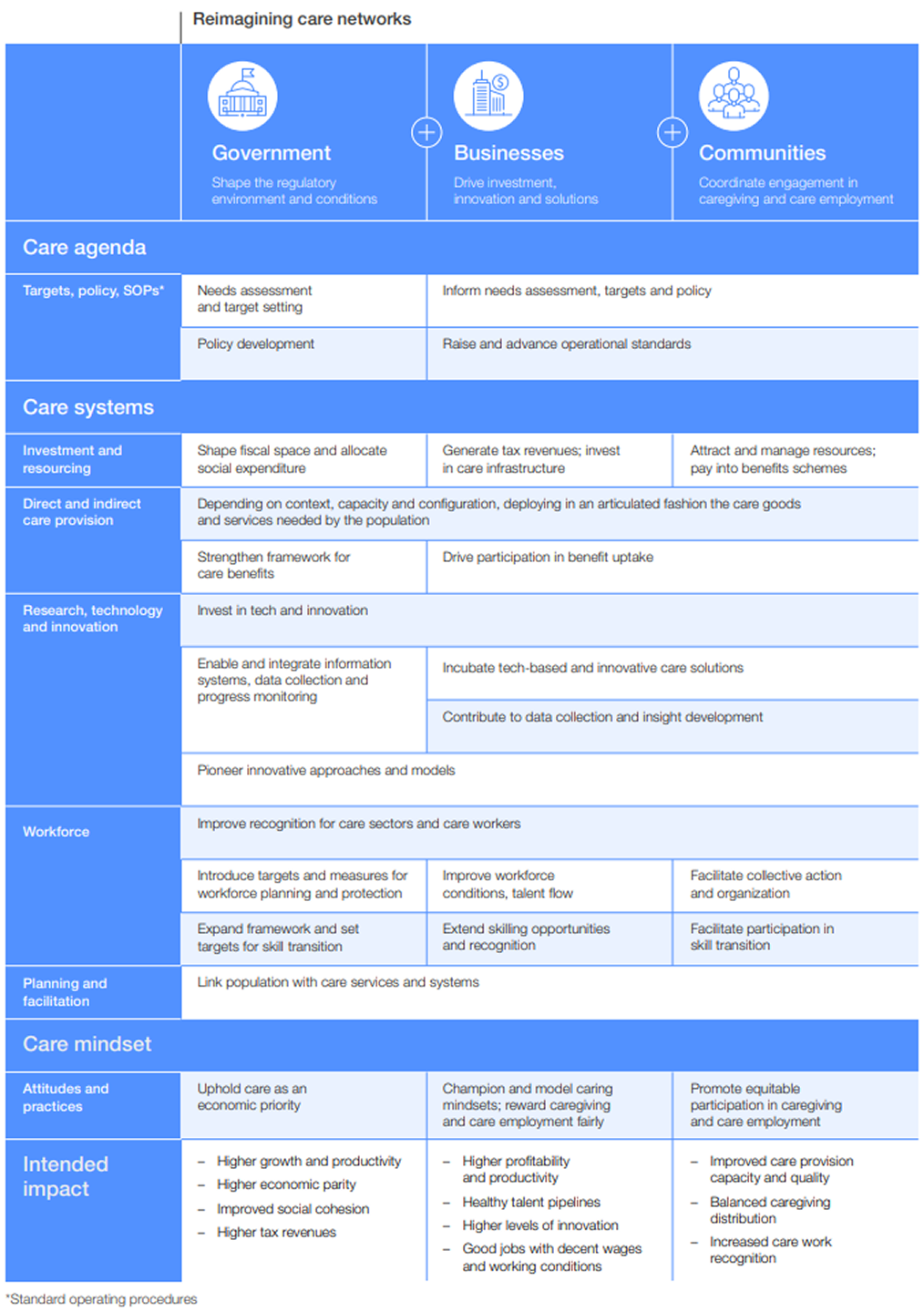
Figure 1- Care Network Framework
Source: The Future of Care Economy Report 2024, World Economic Forum.
A supply push needs to be created. The government can help skill individuals for care work to supply required labour to these business while creating employment oppurtunties. Local governments through public private partnership can provide these care services. This can take off the burden of women while facilitating economic growth. The World Economic Forum suggest that the governments can incentivise businesses to investment in care systems. It also suggests setting up of cooperatives for care work.
A demand pull for care work is essential in order to initiate the process of building a care economy. Here, Roosevelt’s New Deal approach can be undertaken, by injecting money into care work projects. Government spending on care projects can bring legitimacy to the systems. By campaigning, presenting care work as a legitimate career option and providing services at a subsidised rate demand for it can be created.
By outsourcing the care work a significant part of the mental load on women can be taken off at the same time the economic value of the unpaid work can be brought into the economy and enhance the growth of country. The time that women spent on care work can be redirected to education, lesuire etc. This can improve out social outcomes too like improved physical and mental health in women, less domestic trouble and greater participation of women in workforce.
Building care economy is just one part of the solution, a greater part is the change in mindset of people regarding triditional gender roles, distribution of domestic work and emotional labor. This two prong approach can provide women with the support required to bring down their mental load and ensure the well being of almost half of earth’s population.
